



Search has changed dramatically. For years, businesses focused primarily on ranking web pages on traditional search engine results pages. Keywords, backlinks, technical SEO, content optimization, and website authority formed the foundation of online visibility.
Today, people are increasingly asking longer, more conversational questions and using AI-powered search experiences to find information. Google has expanded Search with AI Overviews and AI Mode, while consumers are also using generative AI platforms to research products, services, companies, and solutions. Google itself says that its AI search experiences continue to rely on core Search systems and established SEO fundamentals.
This changing environment has brought three important concepts into digital marketing discussions: SEO, AEO, and GEO.
Although these terms are often used interchangeably, they represent different aspects of how businesses can improve their visibility across traditional search and AI-driven discovery.
What Is SEO?
SEO, or Search Engine Optimization, is the practice of improving a website so that search engines can understand, index, and potentially rank its content for relevant searches. Traditional SEO involves several areas, including:
- Keyword and search-intent research
- Technical SEO
- On-page optimization
- Internal linking
- Content development
- Website architecture
- Page experience
- Authority and reputation
- Local SEO
- Structured data where appropriate
The objective is not simply to place keywords on a page. Modern SEO focuses on whether a page provides useful, relevant, accessible information that satisfies the user’s intent.
Google continues to emphasize that fundamental SEO practices remain important even as AI features become part of Search. Websites still need to be crawlable, indexable, useful, technically sound, and supported by high-quality content. This makes SEO the foundation for the other approaches.
What Is AEO?
AEO stands for Answer Engine Optimization.
Instead of focusing only on ranking a webpage for a traditional keyword, AEO focuses on making information easier for search systems and users to understand when they are looking for a direct answer. Consider the difference between these two searches:
“Digital marketing agency” and “How can a digital marketing agency help a B2B company generate leads?”
The first is a broad commercial query. The second is a question that requires a useful and specific answer. AEO encourages businesses to structure content around real questions and provide clear, concise answers. This can involve:
- Question-based headings
- Clear definitions
- Concise answers near the beginning of sections
- FAQs
- Well-structured content
- Logical content hierarchy
- Supporting evidence
- Relevant examples
- Strong internal linking
AEO is particularly relevant because search interfaces increasingly provide answers directly instead of requiring users to open multiple pages.
However, AEO should not be treated as a replacement for SEO. Google explicitly states that there are no special requirements or additional technical optimizations required specifically to appear in AI Overviews or AI Mode. The same foundational SEO practices remain relevant.
What Is GEO?
GEO commonly refers to Generative Engine Optimization.
The concept focuses on improving the likelihood that a brand, website, product, service, or piece of information is understood and surfaced within generative AI experiences. Instead of asking only:
“How do I rank on Google?”, marketers are increasingly asking: “How can my brand become a reliable source when people ask AI systems about my industry?”
Generative search systems can synthesize information from multiple sources. Google’s current guidance explains that its generative Search experiences use retrieval systems connected to its Search index, which means the underlying quality and discoverability of websites still matter.
GEO therefore involves thinking beyond individual rankings and considering the broader information ecosystem surrounding a brand.
SEO vs AEO vs GEO
The three approaches can be understood more simply:
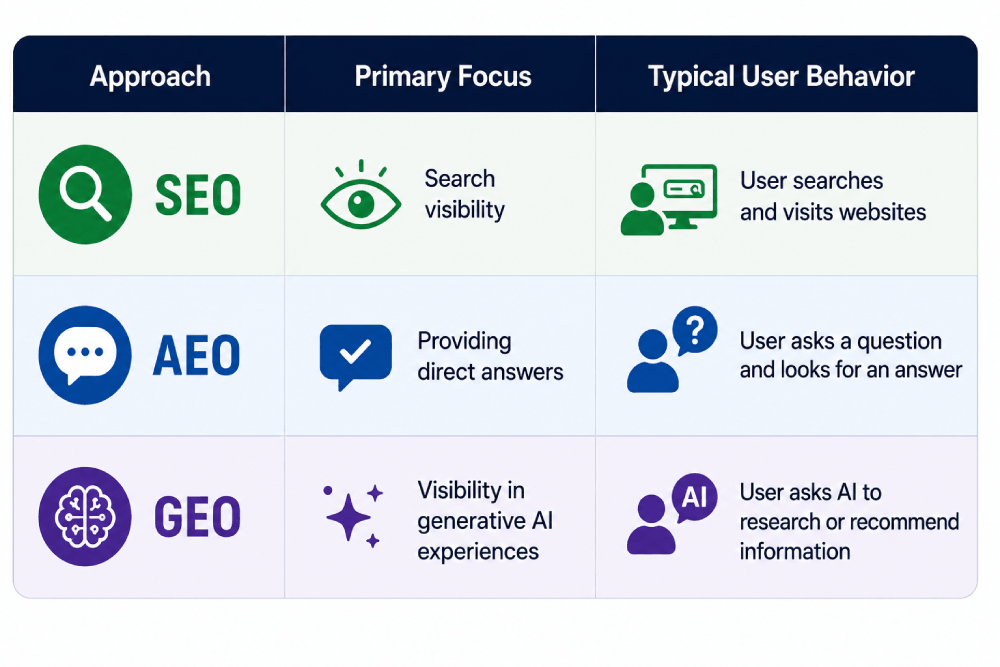
A well-optimized website can support traditional search visibility while also providing the structured, useful information that modern AI search systems need to understand.
Why SEO Still Matters in the AI Era
One of the biggest misconceptions surrounding AEO and GEO is that traditional SEO is becoming irrelevant. That is not supported by Google’s current guidance.
Google states that its AI features are built on its existing Search systems and that SEO best practices continue to be relevant. To be eligible as a supporting link in AI Overviews or AI Mode, a page must still be indexed and eligible to appear in Google Search.
This means businesses should not abandon technical SEO, content quality, website architecture, internal linking, or other fundamentals simply because AI search is growing. Instead, SEO should evolve.
The goal is no longer only to rank for a collection of keywords. Businesses should build a website that clearly communicates what they do, who they serve, what they know, and why their information is trustworthy.
Make Important Information Easy to Understand

AI systems and human visitors both benefit from clear information. Businesses should avoid hiding important information inside overly complicated layouts or unnecessarily vague copy. Important details should be presented clearly:
- What the company does
- Who it serves
- Where it operates
- What services it provides
- What makes its approach different
- What expertise it has
- How customers can contact it
Clear headings, descriptive page titles, concise introductions, logical sections, and relevant internal links can make information easier to discover and understand. Google’s guidance also recommends ensuring important content is available in textual form and that structured data accurately reflects visible content.
Build Topical Authority
A single article rarely establishes expertise around an entire subject. Businesses can instead create topic clusters. For example, a company focusing on digital marketing could build content around:
SEO
- Technical SEO
- On-page SEO
- Local SEO
- Ecommerce SEO
- SEO strategy
- SEO measurement
AEO
- What is AEO?
- AEO vs SEO
- Question-based content
- Featured-answer optimization
- Search intent
GEO
- What is GEO?
- Generative search
- AI visibility
- Brand mentions in AI search
- AI search strategy
Digital Growth
- Performance marketing
- Social media
- Content marketing
- Conversion optimization
- Marketing analytics
This structure creates connections between related topics and gives users multiple paths to explore information.
Structured Data: Useful, But Not a Magic Solution
Structured data can help search engines understand information on a webpage. Depending on the website, relevant structured data may include:
- Organization
- LocalBusiness
- Product
- Article
- Breadcrumb
- FAQ where appropriate
However, businesses should avoid the idea that adding schema automatically makes content visible in AI results. Google’s current guidance specifically says there is no special schema.org markup required for AI Overviews or AI Mode. Structured data should therefore be used correctly and only where it accurately represents visible page content.
Improve Technical SEO First
Before investing heavily in AEO or GEO strategies, businesses should ensure their technical foundation is healthy. Important areas include:
- Crawlability
- Indexability
- Robots.txt
- XML sitemaps
- Canonicalization
- Mobile usability
- Page speed
- Internal linking
- HTTPS
- Broken links
- JavaScript rendering where relevant
- Proper redirects
- Search Console monitoring
If search engines cannot properly discover or understand a website, adding more content may not solve the underlying problem.
Think Beyond Rankings
Traditional SEO reporting often focuses heavily on keyword rankings. Rankings remain useful, but they should not be the only measurement. Businesses should increasingly consider:
- Organic impressions
- Organic clicks
- Qualified organic traffic
- Conversions
- Leads
- Revenue
- Branded searches
- Engagement
- Content-assisted conversions
- Search visibility
- Relevant brand mentions
For AI search, measurement can be more complicated because visibility may occur without a conventional click. This makes brand awareness, direct traffic, branded searches, referral patterns, and qualitative monitoring increasingly useful alongside traditional SEO metrics.
How Brand Bhoomi Approaches the Changing Search Landscape
For businesses navigating this transition, the most effective approach is unlikely to be choosing between SEO, AEO, and GEO.
The stronger strategy is to connect them.
Brand Bhoomi positions its marketing approach around branding, digital growth, content, SEO, performance marketing, social media, website development, and strategic consulting. Its stated growth framework begins with research and market intelligence, moves into strategic transformation, and then focuses on market activation and optimization.
That broader approach is relevant to modern search because visibility is increasingly connected to the entire digital presence of a brand.
A website needs technically sound SEO.
Content needs to answer real customer questions.
Brand messaging needs to remain consistent.
Digital channels need to reinforce one another.
And marketing decisions need to be supported by data.
Rather than treating AI search as an isolated SEO tactic, businesses can consider it part of a larger digital growth strategy.
The Future of Search Is Not SEO vs AI
The rise of AI search does not mean that SEO is disappearing.
Instead, the definition of search visibility is expanding.
People may discover a business through a traditional search result, an AI-generated answer, a social platform, a video, a review, a recommendation, or a conversational search experience.
This means businesses need to think about visibility across the entire digital ecosystem.
SEO provides the foundation.
AEO helps businesses communicate useful answers clearly.
GEO encourages marketers to consider how brands and information are represented within generative search experiences.
Together, these approaches can support a more comprehensive digital visibility strategy.
The evolution from traditional search to AI-assisted discovery represents a major change in how people find and evaluate information.
However, the fundamentals remain surprisingly consistent: businesses need useful information, technically accessible websites, credible expertise, clear communication, strong brand signals, and content that genuinely helps people.
SEO, AEO, and GEO should therefore not be viewed as three completely separate marketing disciplines. They are interconnected approaches to the same broader objective: helping the right audience discover, understand, trust, and engage with a brand.
For businesses planning their next stage of digital growth, the opportunity is not to chase every new AI trend. It is to build a strong digital foundation that can adapt as search continues to evolve. That means investing in strategy before tactics, useful content before content volume, and genuine authority before shortcuts.
For a modern marketing partner such as Brand Bhoomi, this broader perspective brings together strategic branding, SEO, content, digital growth, performance marketing, websites, and other digital channels to create a more connected approach to building brands and generating sustainable growth.
Frequently Asked Questions
What is AEO in Digital Marketing?
AEO, or Answer Engine Optimization, focuses on creating clear, structured, and informative content that directly answers user questions. It helps businesses improve their visibility in search experiences where users expect quick and relevant answers. AEO strategies often include question-based content, FAQs, concise explanations, logical headings, and content aligned with search intent.
What is GEO in Digital Marketing?
Is AEO replacing traditional SEO?
No. AEO complements traditional SEO rather than replacing it. Technical SEO, quality content, search intent, website accessibility, internal linking, and authority remain important foundations for online visibility. Businesses should combine SEO fundamentals with answer-focused content to address changing search behavior and provide useful information across traditional and AI-powered search experiences.
How is GEO different from SEO?
EO primarily focuses on improving a website’s visibility in traditional search engine results, while GEO considers how brands and information may be represented within generative AI experiences. Although their objectives differ, both rely on relevant, trustworthy, accessible, and well-structured information to help search systems understand a business and its expertise.
How can businesses optimize content for AI search?
Businesses can create useful, well-structured content that directly answers customer questions and provides clear information about their expertise. They should also maintain accurate brand information, demonstrate relevant experience, organize content logically, and ensure their website is technically accessible. Consistency, originality, and usefulness are important when developing content for evolving AI search experiences.
Does AI-generated content improve GEO?
AI can support research, content planning, organization, and optimization, but simply producing large amounts of AI-generated content does not guarantee better visibility. Businesses should prioritize accurate, original, useful, and trustworthy information. Human expertise remains important for adding context, industry knowledge, brand perspective, examples, and meaningful insights that provide genuine value to readers.