



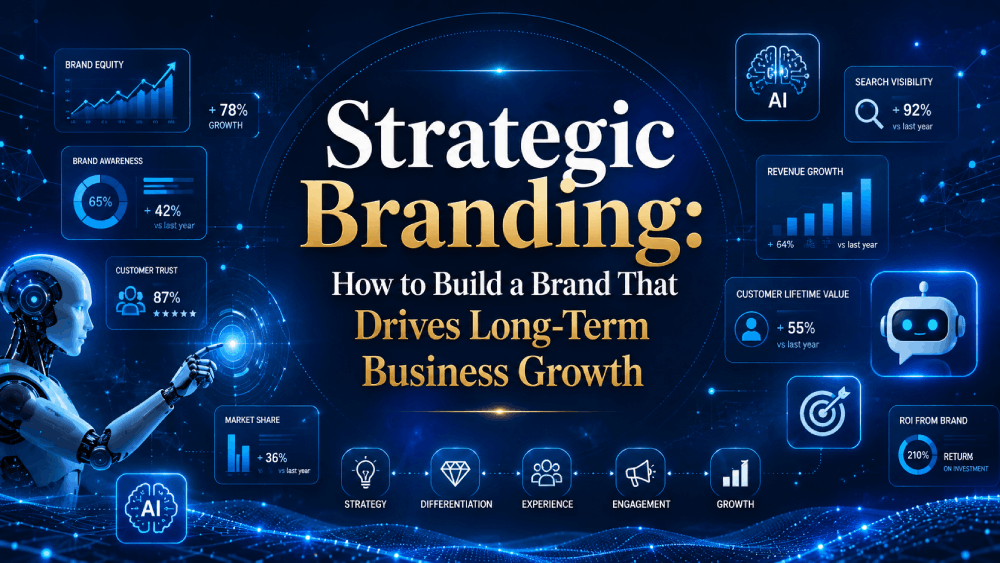
There was a time when a brand could distinguish itself through a distinctive logo, an elegant identity system, a memorable tagline, and a well-designed campaign.
That time has changed.
Today, almost everything can be replicated. A visual language can be imitated. A website can be rebuilt. A campaign can be reproduced. A competitor can adopt the same vocabulary, the same channels, and increasingly, the same technology.
What is harder to reproduce is meaning.
The brands that create the greatest value are not always the ones making the most noise or investing the most heavily in visibility. They are the ones that earn a clear and memorable place in the minds of their audience. Brands with a distinct point of view, a recognizable identity, and a value people can immediately understand.
For leaders, that distinction matters. Because when positioning is unclear, marketing becomes expensive noise. When positioning is clear, every expression of the business, from the website and sales narrative to content, search, and customer experience, starts working from the same strategic center.
The Difference Between Having a Brand and Building One
Let’s start with understanding the agenda: a brand exists in the space between what a company says about itself and what the market believes about it. That distinction is fundamental.
A company may describe itself as innovative, premium, customer-centric, technology-led, or purpose-driven. Those words have little value unless customers encounter evidence of them consistently. A brand is shaped by what people remember, what they associate with you, what they expect from you and, ultimately, why they choose you when alternatives are available.
Strategic branding is the discipline of influencing that perception with intention. It begins long before the logo and continues long after the brand guidelines are approved. It asks a more commercially important question than “Does this look good?” It asks: “What should this business mean to the market?”
Branding Is Not Decoration. It Is Direction.
One of the most persistent misconceptions about branding is that it is primarily visual. The logo is redesigned. The colour palette is refreshed. The typography is refined. The website receives a more contemporary aesthetic. The project is then called a rebrand.
But if the business has not reconsidered its positioning, its audience, its competitive advantage, its proposition or the experience it wants to create, very little has actually changed.
Design is the expression of a brand strategy. It is not the strategy itself.
A strong visual identity can make a brand recognisable. Recognition, however, is not the same as differentiation. A business can be beautifully presented and still be difficult to distinguish.
The strategic question is not simply, “How should this brand look?” It is, “What should this brand be known for?” Once that is answered, design becomes considerably more powerful because it has something meaningful to express.
The Most Valuable Real Estate Is the Mind
In crowded markets, attention is expensive. But attention alone is not the objective.
A business can generate millions of impressions and remain forgettable. The more valuable advantage is mental availability combined with distinctive meaning: when a need arises, which names come to mind, and what does each name stand for?
When a founder thinks about a strategic marketing partner, which company feels credible? When a procurement team evaluates suppliers, which names feel established enough to trust? When a customer considers a premium option, which brands immediately feel worthy of consideration?
Those associations do not appear by accident. They are built through repeated exposure, distinctive assets, consistent messaging, customer experience, reputation and, above all, clear positioning.
The strongest brands understand that they cannot own every idea. They choose the territory they want to occupy and then build relentlessly around it.
Positioning Is the Architecture Behind the Brand
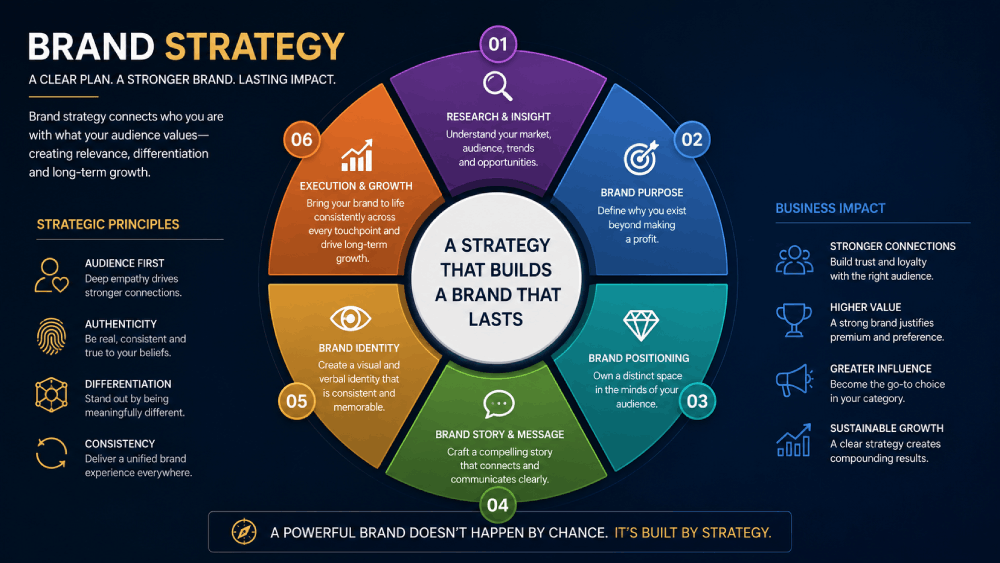
Positioning is at the heart of strategic branding because it determines the space a business wants to occupy in the customer’s mind.
The question sounds simple: Why should the market choose this brand instead of another?
The answer cannot simply be “We provide quality.” Everyone says that. “We are customer-centric” is rarely enough either. “We deliver innovative solutions” has become so common that it often communicates almost nothing. Strong brand positioning is specific. It clarifies the audience, the category, the value proposition, and the reason to believe. It creates a point of view.
A generic agency might say, “We provide digital marketing services.”
A strategically positioned business might say, “We become the strategic marketing function for ambitious businesses that need senior leadership without the cost of a full-time CMO.”
The second statement does more than describe a service. It identifies an audience, a need, a value proposition, and a distinctive role. It gives the market something to remember. That is what a strategic brand strategy should do: create clarity before communication begins.
The Premium Brand Is Not the Brand That Looks Expensive
Premium positioning is often mistaken for an aesthetic exercise. Businesses reach for restrained colors, sophisticated typography, minimalist layouts, and polished photography in the hope that the brand will feel more valuable. A unique perception does not originate in aesthetics alone. It comes from value, confidence, consistency, and distinction.
A valuable brand knows what it is. It knows what it is not. It does not try desperately to appeal to everyone. It does not chase every trend. It does not explain itself endlessly. It does not reduce its value every time the market hesitates. That principle applies well beyond luxury. A B2B technology company, professional services firm, healthcare organization, education business, or emerging consumer brand can create a premium perception when its strategic foundations are strong.
A Strong Brand Makes Marketing More Intelligent
Branding and marketing are often treated as separate disciplines. They should not be.
Marketing creates reach. Branding creates meaning.
Performance marketing can generate a click. Content can create engagement. SEO can create discovery. Social media can create visibility. A website can create conversion. But none of these channels can compensate indefinitely for an unclear proposition.
When positioning is weak, marketing simply amplifies the confusion. Campaigns multiply, but the story remains fragmented. Content gets published, but the brand has no distinctive point of view. Traffic increases, but trust does not necessarily follow. Leads arrive, but they may not be the right leads.
Strategic branding brings the system together.
Positioning informs messaging. Messaging informs content. Brand strategy informs the digital experience. Experience influences perception. Perception influences preference. Preference influences growth. For businesses investing in a broader brand growth strategy, this is also where strategic branding services become valuable: not as a replacement for marketing execution, but as the thinking that makes execution work harder.
Strategic Branding Is Even More Important in B2B
B2B brands face a particular challenge: the buying decision is rarely made by one person, in one moment, for one simple reason.
There may be multiple stakeholders, longer sales cycles, higher perceived risk, and several rounds of internal evaluation. In that environment, credibility becomes part of the product.
A B2B buyer is quietly asking:
Can you solve my problem?
Do you understand my business?
Can I trust your expertise?
Why should I choose you?
Why should I pay your price?
Strategic branding helps answer those questions before the sales conversation begins.
That is why B2B branding strategy must extend beyond identity design. Founder visibility, LinkedIn presence, thought leadership, case studies, website messaging, customer proof, and the consistency of the digital experience all contribute to the brand a prospective buyer encounters.
For professional services and technology companies in particular, expertise itself can become a brand asset. The strongest brands do not simply list capabilities. They demonstrate how they think.
The New Brand Battlefield Is Digital and Increasingly Intelligent
For decades, brands primarily competed for human attention. Increasingly, they also need to be understood by machines.
Search engines, recommendation systems, and generative AI are becoming part of how people discover companies, products, experts, and services. People ask Google, ChatGPT, Gemini, Perplexity, and other systems which companies lead a category, which agencies specialize in an industry, which solutions are credible, and what alternatives are worth considering.
The implications for strategic branding are significant.
A brand now needs to be understandable as an entity, not merely attractive as an identity. Its website, leadership profiles, LinkedIn presence, thought leadership, media coverage, case studies, reviews, and third-party references should reinforce a coherent story about who the company is, what it does, who it serves, and what it is known for.
This is where strategic branding increasingly intersects with SEO, AEO, GEO, digital reputation, and AI-search visibility. The objective is not to manufacture an artificial presence. It is to build a body of consistent, useful evidence that makes the brand easier to understand for people and for the systems helping people make decisions.
In that environment, brand consistency becomes more than a design principle. It becomes part of digital credibility.
The Strongest Brands Have a Point of View
One of the clearest differences between an ordinary brand and an influential one is the willingness to have an opinion.
Generic brands describe what they do. Strong brands articulate what they believe.
They have a perspective on their category. They challenge conventions. They define standards. They create language around problems their customers may not yet know how to articulate.
This is particularly important when products and services become increasingly similar. Thought leadership becomes a dimension of differentiation because expertise is no longer demonstrated simply by listing capabilities. It is demonstrated through the quality of one’s thinking.
A business that consistently contributes useful, original ideas begins to accumulate authority. Over time, that authority becomes an asset.
For a strategic branding agency, this is one of the most important shifts to recognise: the brand is no longer expressed only through campaigns. It is expressed through the quality and consistency of the ideas a company puts into the market.
Strategic Branding Is the Discipline of Choice
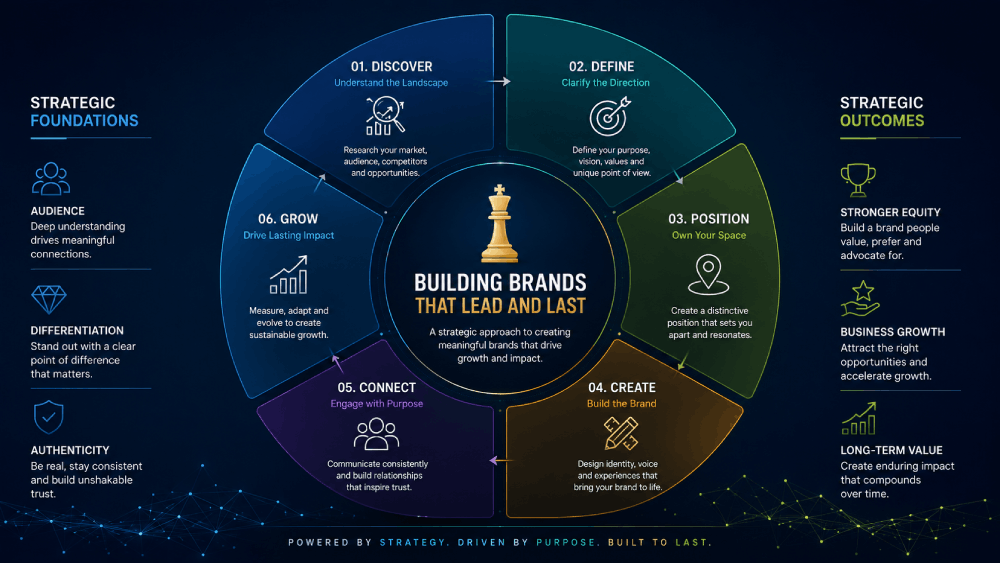
Perhaps the hardest part of building a brand is deciding what not to say.
Every business has multiple capabilities. Every founder has multiple ambitions. Every organisation has dozens of things it could communicate. But a powerful brand cannot give all of them equal weight.
Strategic branding requires choices. Which audience matters most? Which problem do we want to be known for solving? Which category do we want to own? Which attributes should we consistently reinforce? Which opportunities should we deliberately decline? What should people remember when everything else has been forgotten? The answers create focus. Focus creates distinction.
This is also why the best brand strategy consultant is not simply the person who produces a brand book. The real value lies in helping leadership make the choices that the brand must live by across marketing, sales, product, customer experience and growth.
From Brand Identity to Brand Equity
A visual identity can be created in weeks. Brand equity takes years.
It is built through thousands of small interactions: a customer encounter, a sales presentation, a founder’s point of view, a product experience, a website, a conversation, a recommendation, a review, a piece of thought leadership, a promise kept and a problem solved.
Over time, these interactions accumulate into something far more valuable than a logo. They create expectation.
And expectation is one of the most powerful assets a brand can own. When people know what a brand stands for and consistently experience it trust becomes easier to earn. Preference becomes easier to create. Growth becomes easier to sustain. This is the long-term value of strategic brand development. The goal is not to create a campaign that performs for a quarter. It is to create a business identity that becomes more valuable as the business keeps delivering on it.
The Future Belongs to Brands With Clarity
Technology has democratised access to sophisticated design. AI has democratised content production. Digital platforms have democratised distribution.
But none of these technologies have democratised meaning. Thousands of businesses can produce content. Far fewer can develop an original point of view. Thousands can create beautiful identities. Far fewer can occupy a distinctive position in the market. Thousands can advertise. Far fewer can become the brand people actively seek.
That is the opportunity strategic branding creates.
Not simply visibility. Not simply recognition.
Relevance. Preference. Trust.
And ultimately, the ability to build a business that means something beyond the products or services it sells.
The businesses that stand out in an increasingly crowded market will not necessarily be the ones making the most noise. They will be the ones with the clearest point of view, the strongest positioning and the discipline to express their value consistently at every touchpoint.
That is the real work of strategic branding. It is not about creating a prettier brand. It is about creating a more meaningful, differentiated and valuable one.
At Brand Bhoomi, that philosophy sits at the intersection of brand strategy, marketing leadership, digital growth and emerging AI-driven discovery. The aim is not to make a business look bigger than it is. It is to make its value impossible to misunderstand.
About the Author
Jineesha Gandhi is the Founder & CEO of Brand Bhoomi, a strategic branding and digital growth firm. She is a Fractional CMO, Brand Architect and Digital Growth Expert, working with businesses and brands to define positioning, build differentiated identities, create growth strategies and connect brand thinking with digital performance.
Her work sits at the intersection of brand strategy, business growth, digital transformation and emerging AI-driven discovery. Her approach is rooted in a simple belief: A strong brand is built on more than distinctive visuals. It needs a clear strategic foundation, a consistent voice, and a meaningful value proposition that can earn trust, create preference, and support sustainable business growth.
A Quiet Invitation
Brand Bhoomi works with ambitious businesses that need more than marketing activity, they need strategic clarity, sharper positioning and a growth system that can scale with the business. Where the challenge is brand, growth, digital transformation or marketing leadership, the conversation should begin with the business problem, not a list of services.